Driveways and Walkways: A Decision Framework for Layout, Traction, and Curb Appeal
Choosing an approach to the front door sounds simple until Michigan weather weighs in. A driveway that looks crisp in July can become slick, uneven, or hard to maintain by February. A walkway that photographs beautifully can feel awkward to use if it fights the natural path people take—or if meltwater refreezes in the wrong places.
This article lays out a practical decision framework for planning approach areas that are safe to walk, easy to live with, and visually coherent with the home. It does not assume there’s one “best” material. Instead, it shows what to evaluate—slope, drainage, traffic patterns, traction, edges, and maintenance—so the finished project performs as well as it looks.
Hardscape Design & Installation
Why this decision matters more in Michigan than most homeowners expect
Michigan winters are hard on approach areas because they combine the factors that stress surfaces the most: frequent freeze-thaw cycles, de-icing products, and repeated mechanical wear from shoveling and plowing. The result is that design decisions that might be “good enough” in a milder climate can become long-term annoyances here.
A well-planned driveway and entry approach does two jobs at once. It supports safe movement—foot traffic, strollers, deliveries, kids, pets—through wet and icy conditions. And it frames the home with an intentional first impression that holds up over time.
The three things that usually go wrong first: traction, drainage, and edges
Most failures start at the points that are easiest to overlook.
Traction issues often show up at transitions: the top step, the landing outside the front door, or the first few feet where a walkway meets the driveway. Smooth finishes, shallow slopes, and shaded exposure can combine to create recurring slip risk.
Drainage problems show up as standing water, ice sheets, or persistent wet spots along the approach. When water doesn’t move away from the path, it doesn’t just freeze—it also pushes on the base and joints beneath the surface.
Edges fail when restraints and transitions are not designed to hold. Once the perimeter starts to spread or sink, the surface may still “look okay” from a distance, but the approach will feel uneven underfoot and become harder to clear in winter.
When “curb appeal” conflicts with daily use—and how to plan for both
Many homeowners focus on the visible choices first: pattern, border, color, and material. Those are important, but they should be built on the decisions that make the approach function. The goal is not to choose between appearance and usability. The goal is to design for both, so the look is supported by a layout and construction approach that performs in real conditions.
Start with the site, not the surface
Before talking about materials, start with two questions: where does water go, and how do people actually move through the space?
A strong layout follows the site’s realities rather than forcing a shape that needs constant correction. That is especially true in Metro Detroit, where subtle grading changes can lead to unexpected puddling and refreezing.
How slope and runoff determine the safest, cleanest layout
Slope is not just a visual factor. It determines where meltwater and rain travel, and where ice forms first.
- If the driveway slopes toward the garage, water can pool at the slab edge and refreeze. That creates a recurring maintenance problem and can contribute to surface wear.
- If a walkway runs along a low point of the yard, it may become the “collection channel” for water during storms.
- If a path is built without considering cross-slope, it can hold thin films of water that freeze overnight.
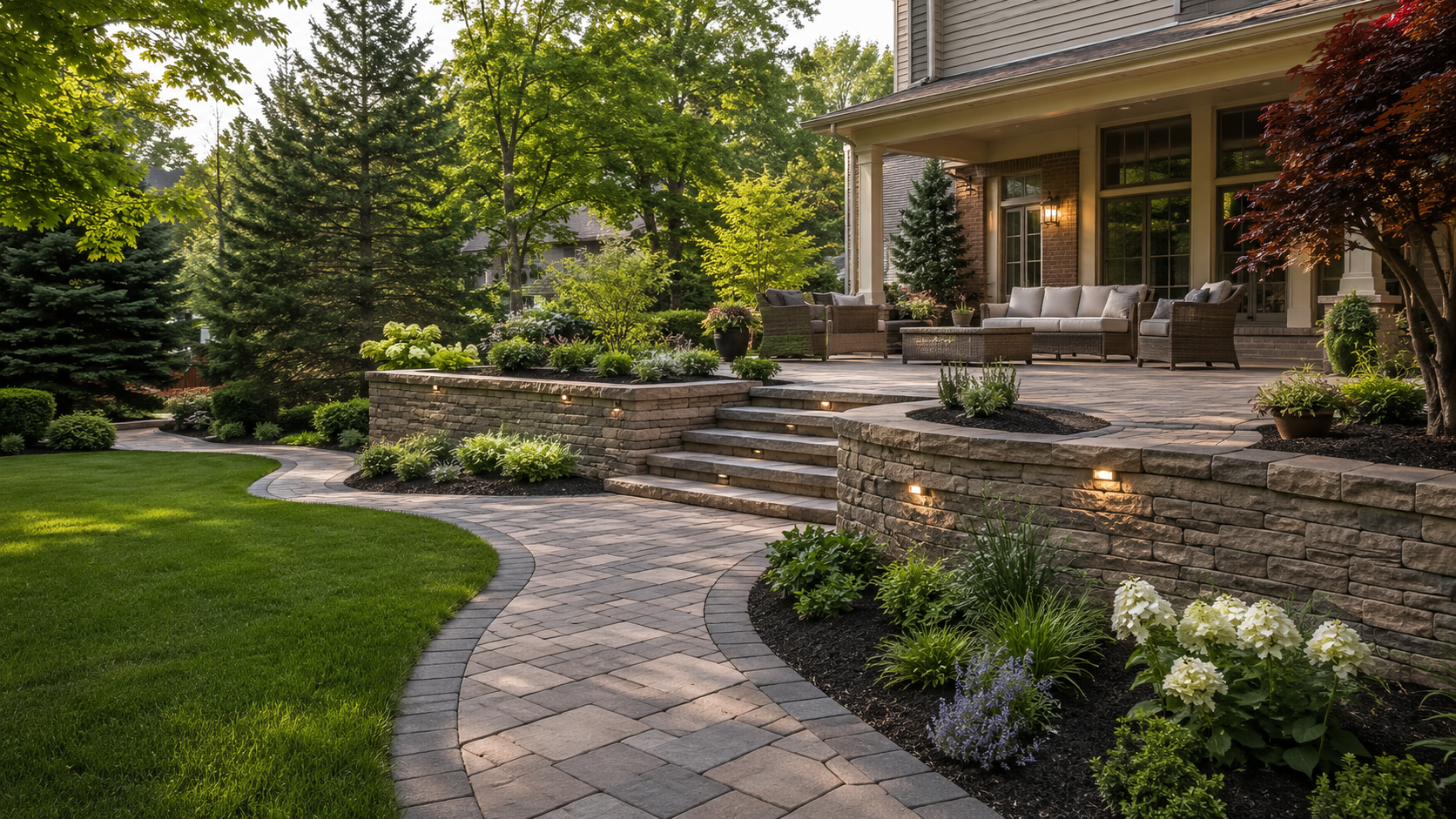
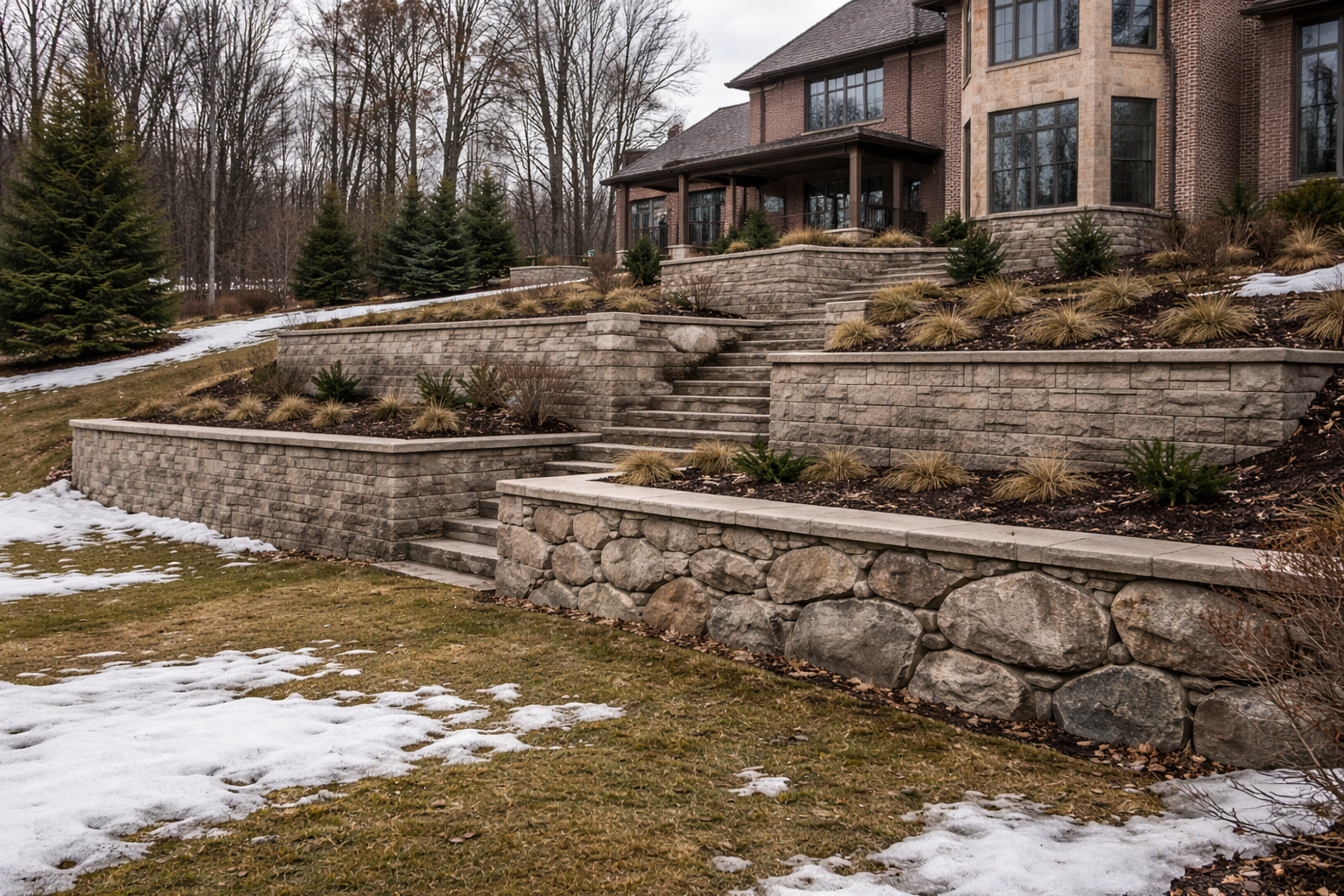
A functional approach uses grade to move water away from walking surfaces and away from the home—without creating uncomfortable pitch. When slope is significant, the safest solution is often a design that breaks grade changes into manageable segments: steps with proper landings, or a route that reduces steepness through gentle alignment.
Where walk paths naturally want to go (and why fighting that creates maintenance issues)
People are consistent. If the most natural line from the driveway to the front door is diagonal, forcing a tight ninety-degree path often results in “desire lines”—grass worn down where people cut across beds or corners.
A walkway that follows natural movement tends to stay cleaner, because it is used as intended. It also simplifies snow clearing because the route is direct and predictable.
The best test is simple: watch how guests approach the home during a gathering, and notice where deliveries tend to land. A layout that respects those patterns will feel right without needing explanation.
Placement rules that reduce ice buildup and puddling around entries
A few placement decisions reduce winter issues dramatically:
- Avoid placing walkways in the lowest drainage corridor of the front yard.
- Plan for downspout discharge and roof meltwater paths so they do not cross the primary entry route.
- Give landings enough space so people are not stepping from a door directly onto a sloped surface.
- Consider exposure: north-facing, shaded areas hold ice longer; sunny areas melt and refreeze more frequently.
The goal is not to eliminate ice entirely—Michigan makes that unrealistic. The goal is to design the approach so ice is less frequent, less severe, and easier to manage.
Layout choices that hold up through real traffic
Approach areas are not decorative zones. They are working surfaces that carry vehicles, foot traffic, and winter equipment.
Straight runs vs. curves: what they change for usability, shoveling, and repairs
Curves can be visually soft and can help a walkway feel more integrated with the landscape. But curves add complexity.
From a usability standpoint, curves tend to lengthen the route. If the curve does not match natural movement, people will cut across it.
From a maintenance standpoint, curves create more edge length, more joints, and more places for minor shifting to become noticeable. They can also make snow clearing less efficient, especially if the approach is narrow.
From a repair standpoint, curves often require more careful re-setting to maintain a clean line. That does not mean they are a bad choice. It means they should be selected intentionally, not by default.
Width and turning radius: planning for real vehicles, not ideal conditions
Driveway sizing should be based on how the property is actually used.
- Do vehicles turn in, back out, or pass each other?
- Do guests park in the driveway during gatherings?
- Does the household have larger vehicles that need more turning room?
A driveway that is too tight may function most of the year, then become stressful when snowbanks narrow the usable width. A practical plan anticipates those seasonal constraints.
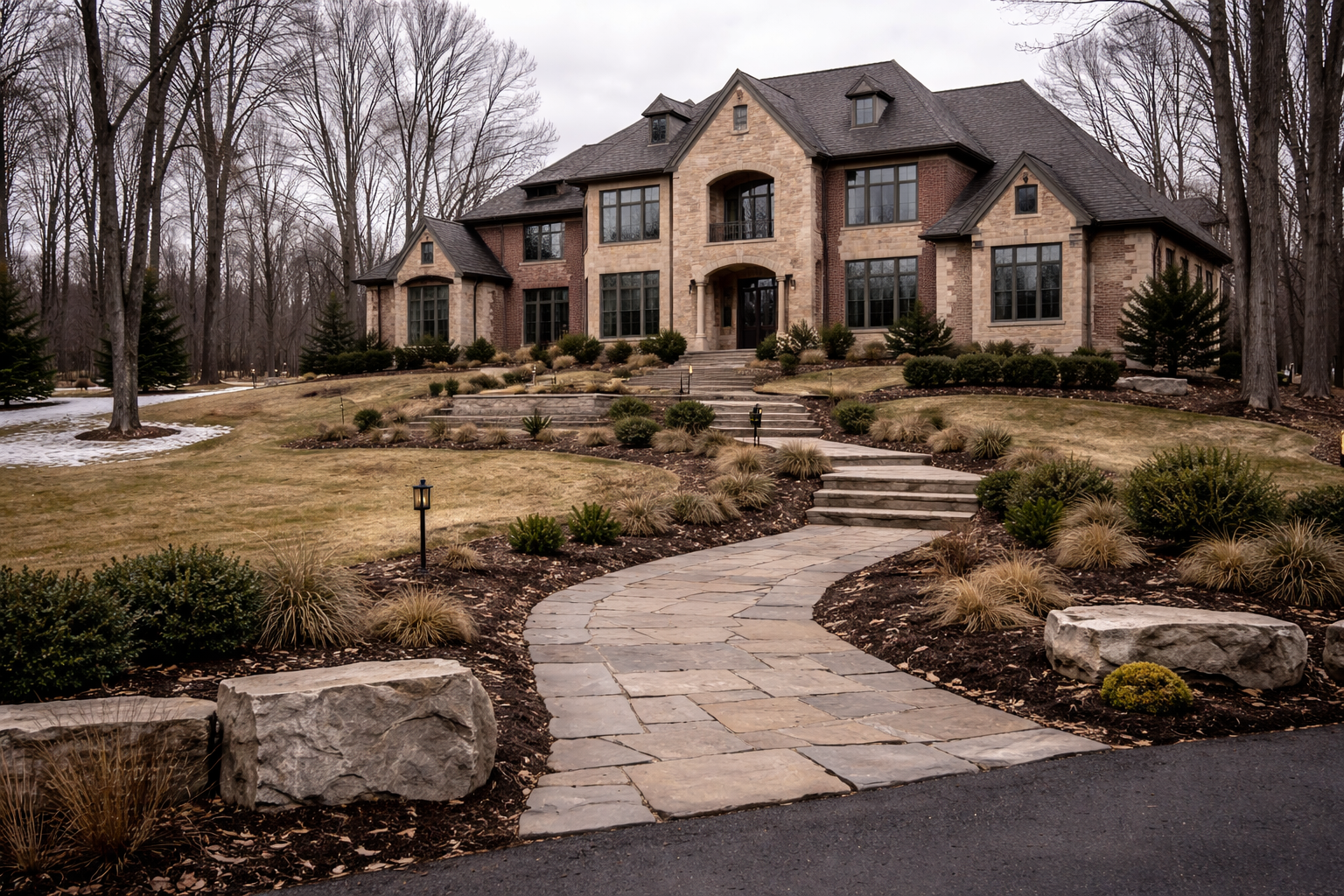
How to connect driveways and walkways so the whole approach feels intentional
The strongest approach designs treat the driveway, walkway, and entry landing as one composition. When these elements are designed separately, the result often looks fragmented: the driveway feels like an asphalt replacement project, and the walkway feels like an add-on.
This is where the keyword driveways and walkways fits naturally because homeowners are rarely choosing these elements in isolation. When they are coordinated, aligned to sightlines, scaled to the home, and connected through consistent transitions, the approach reads as designed rather than assembled.
Traction and winter performance: what to evaluate before picking a look
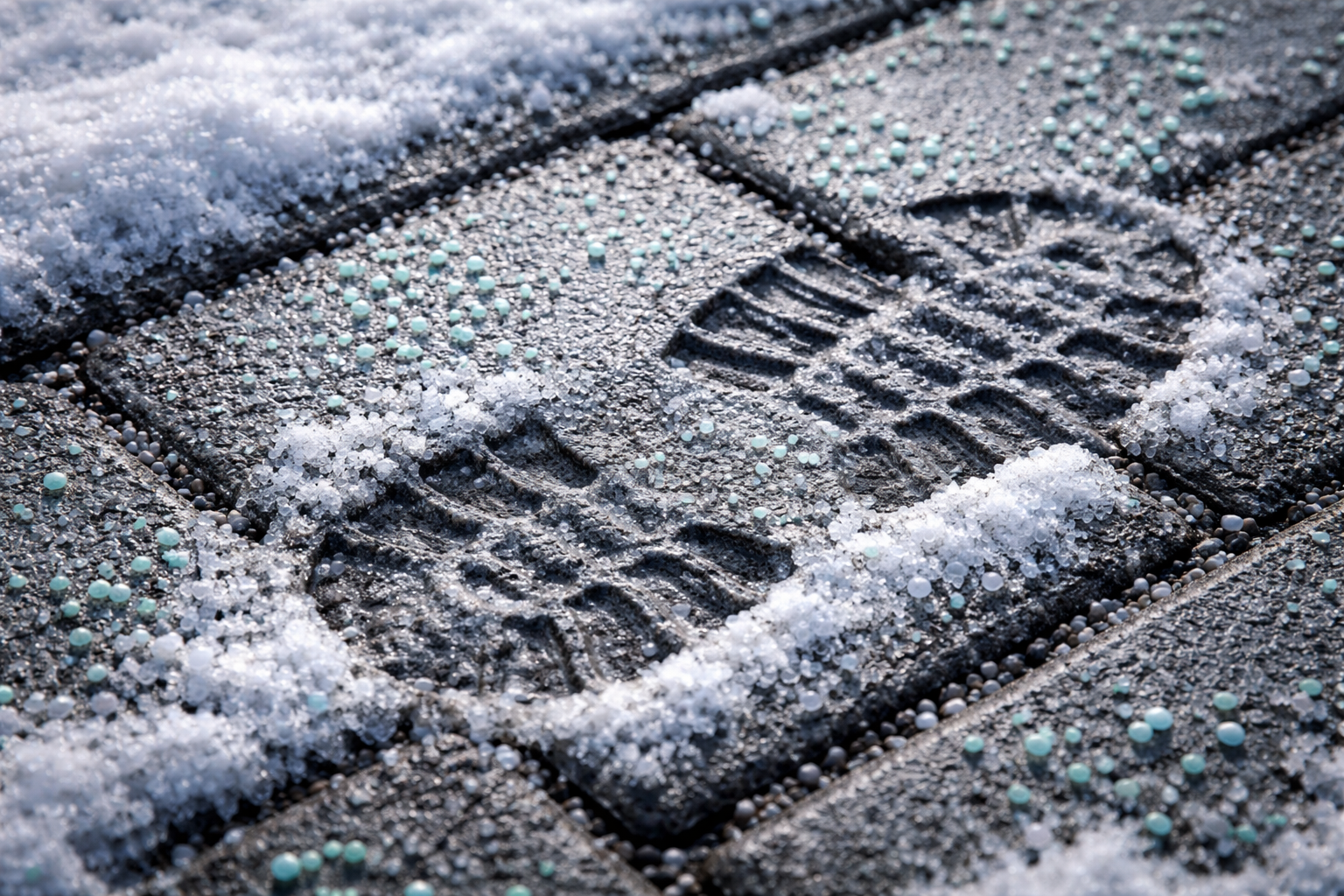
Traction is not a single property of a material. It is the result of finish texture, slope, jointing, exposure, and maintenance.
Surface texture and jointing: what actually affects grip underfoot
Textured finishes generally provide better grip than polished or very smooth surfaces, especially when wet. Jointing also matters. A surface with appropriate jointing can offer subtle “breaks” that help with grip, while overly wide or inconsistent joints can collect water and freeze.
The goal is predictable footing. That means avoiding surfaces that become slick when a thin film of water sits on top, and designing joints so they do not become ice grooves.
How grade and finish interact (the same material can behave differently on different slopes)
The same surface can feel safe on a flat landing and risky on a steeper run. That is why evaluating grade is non-negotiable.
If a walkway must handle slope, the safest approach often involves one or more of the following:
- introducing steps with proper landings,
- selecting a finish with strong traction,
- adjusting alignment to reduce steepness,
- and ensuring water is moved away from the walking surface.
Where slip risk tends to concentrate: steps, landings, transitions, and tight corners
Slip risk concentrates where movement changes: stepping down, turning, or crossing a threshold.
- Steps need consistent rise and run, with landings that provide real pause space.
- Landings should not pitch toward the door.
- Transitions between materials should be flush and stable.
- Tight corners should not be placed at the steepest part of a route.
A thoughtful plan treats these as primary design points, not details to be solved at the end.
Paver vs. stone vs. brick: choosing the right system for your priorities
There are good options in every category. The “right” choice depends on how you prioritize traction, maintenance, repairability, and aesthetics.
When paver driveways make the most sense (and when they don’t)
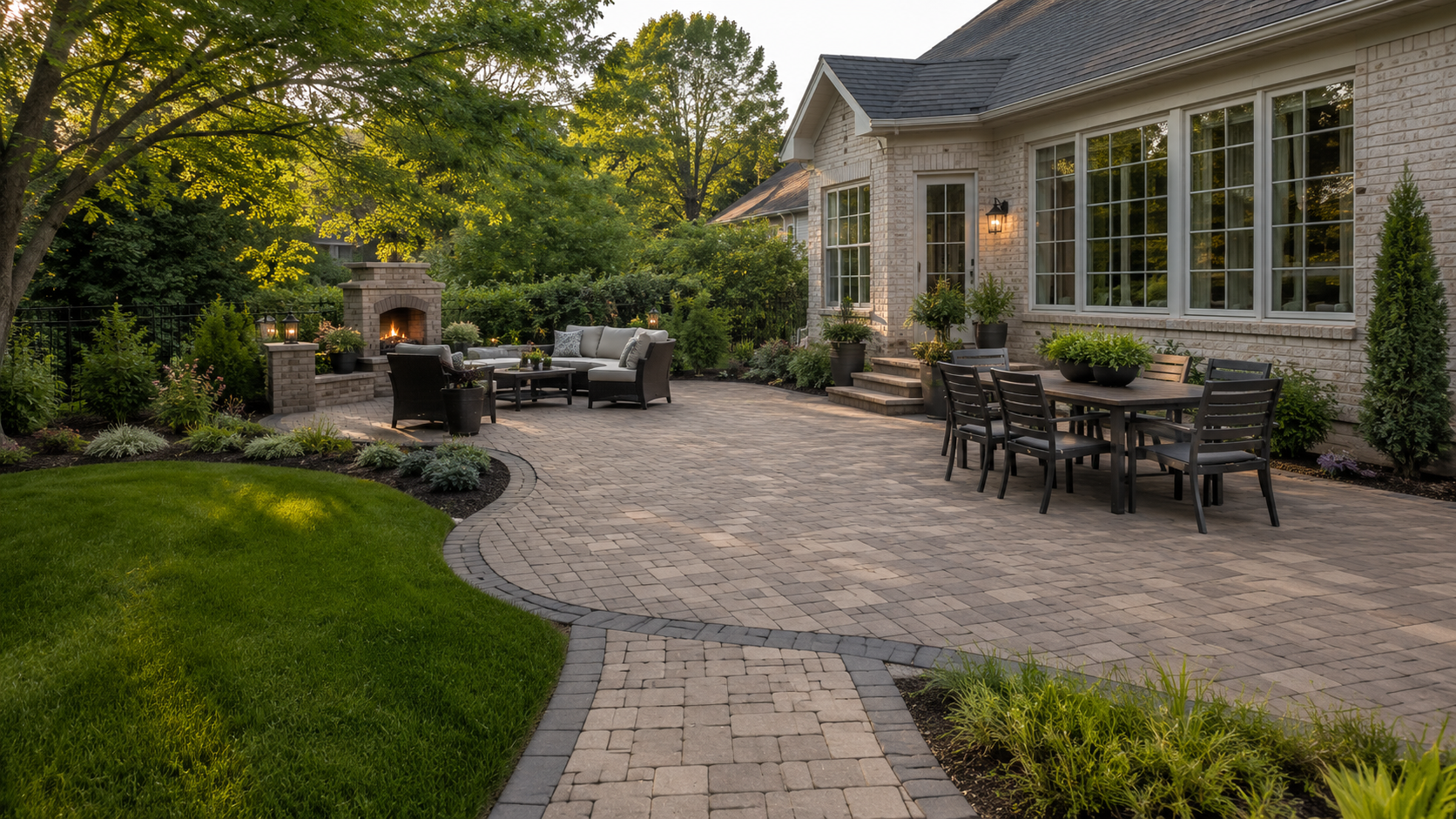
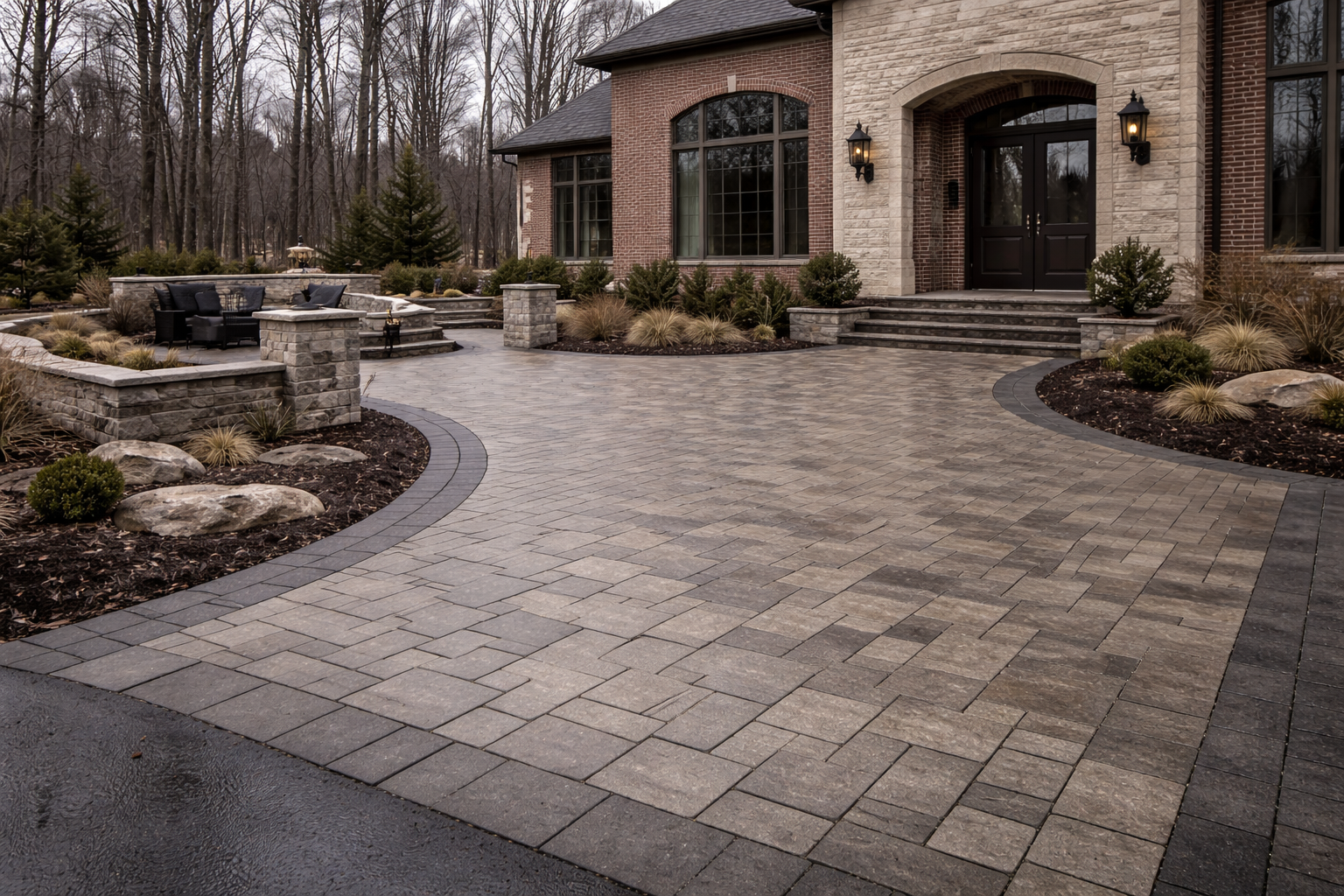
paver driveways are often chosen for their modular repairability and the refined look they can create when installed correctly. If a section ever needs to be accessed or re-leveled, pavers allow localized repair without replacing an entire slab.
They can also be a strong fit when the homeowner wants a deliberate design language—borders, soldier courses, or patterns—without committing to a single continuous surface.
Where they can fall short is when the base and edge restraint are not executed properly. Without strong perimeter control and compaction, shifting begins at the edges, and the surface becomes harder to keep clean and level over time.
Where stone walkways excel, and where they can become fussy
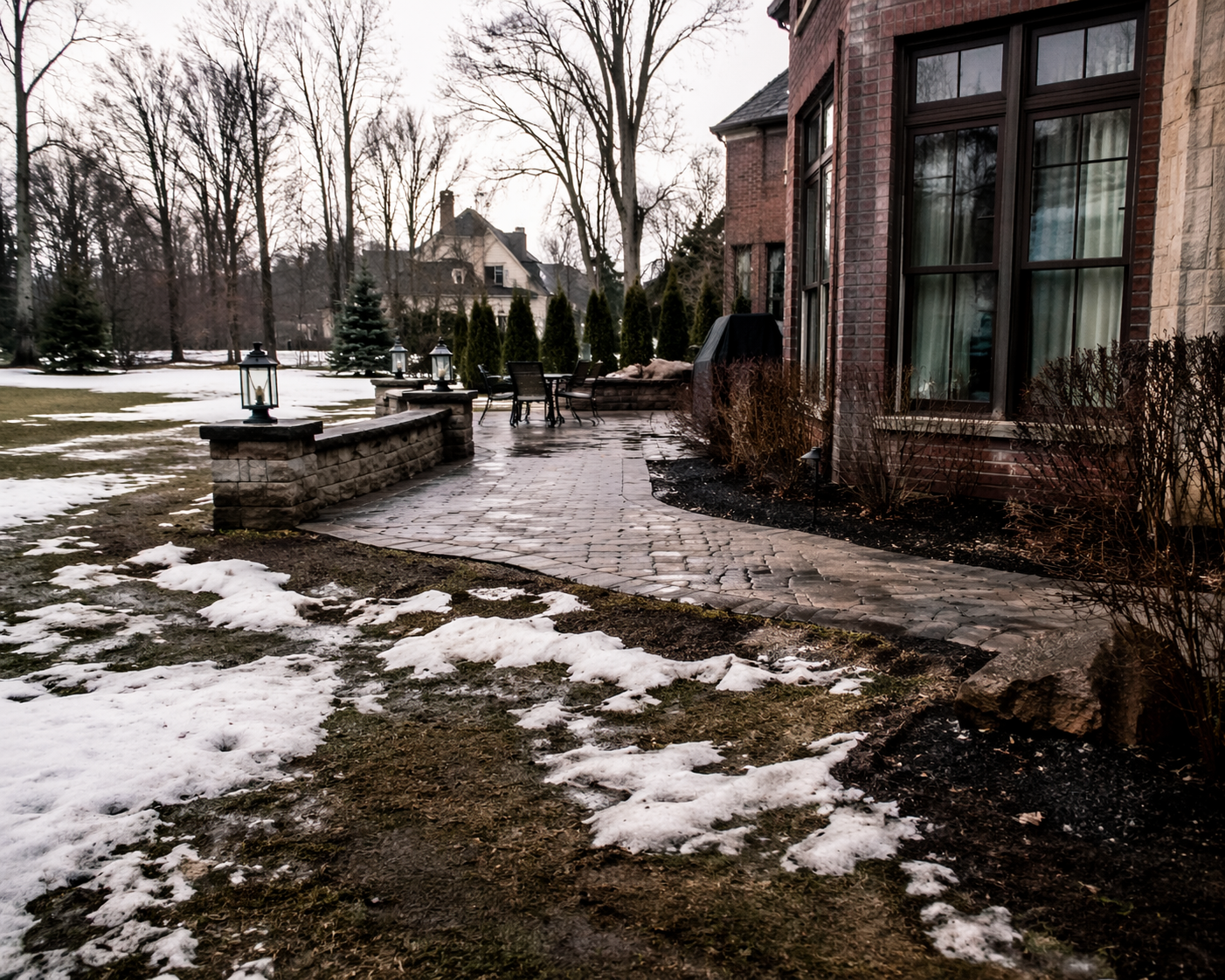
stone walkways can feel timeless and natural, particularly when the stone selection matches the home’s architecture and the surrounding planting style. They can also handle visual transitions well, moving from driveway to entry through a softer, more garden-integrated route.
The tradeoff is that stone can demand more attention to bedding, leveling, and jointing. Irregular shapes and variable thicknesses require careful installation. In winter, the surface texture and joint strategy become even more important, because unevenness can catch shovels and allow ice to form in low points.
Stone is often at its best when the design embraces its character and the installation is built to keep the surface consistent underfoot.
What homeowners mean by “classic” and what it costs to maintain it
When homeowners say they want a “classic” look, they often mean proportions and restraint: a surface that complements the home rather than competing with it. Classic choices tend to be less about trend and more about materials that age well.
Maintenance cost is the part that should be acknowledged upfront. Some classic looks require regular cleaning, attention to joint material, and a realistic plan for managing winter staining and de-icing effects.
The durability reality of mixed-material approaches
Mixing materials can create a high-end look when the transitions are intentional. It can also create weak points if the edges and elevation relationships are not engineered.
A mixed approach should answer these questions:
- How will the materials meet cleanly?
- Will one material shift differently than the other?
- Are the elevations set so water does not trap at the seam?
If those answers are unclear, the design is not ready.
The durability checklist homeowners should use (regardless of material)
Durability is mostly built beneath the surface. Homeowners do not need to know every technical detail, but they should understand what matters.
Base depth and compaction: the hidden work that determines longevity
A stable base is the difference between a surface that stays level and one that slowly moves with seasons. Compaction must be consistent, and base materials must be installed in a way that supports drainage rather than trapping water.
When homeowners compare proposals, base scope is one of the most important items to clarify, because it is one of the easiest places for a bid to look cheaper on paper while costing more later.
Edge restraint and transitions: why most shifting starts at the perimeter
Edges are where surfaces spread, settle, and show movement first. Strong edge restraint is not optional for approach areas that experience vehicle traffic and seasonal expansion.
Transitions matter just as much: where a driveway meets a walkway, where a walkway meets a porch, and where the surface meets turf. Clean transitions protect the structure and the visual line.
Joint strategy and sand type: what affects weed pressure and washout
Jointing is often treated as cosmetic, but it affects stability and maintenance. If joints wash out, water enters the system more easily. If joints are inconsistent, they can collect water and become ice points.
Weed pressure is not purely a joint issue—it also depends on surrounding landscape maintenance and organic debris—but joint strategy influences how much work it takes to keep the surface clean.
Drainage integration: how to avoid heaving, settling, and standing water
Heaving and settling often trace back to water management. If water is allowed to sit within the base or at the edges, freeze-thaw will move the surface.
A durable approach integrates drainage into the plan: grading, runoff paths, and—when necessary—subsurface solutions that move water away from the system.
“Brick and stone driveways”: what that phrase really implies in build decisions
Homeowners often use the phrase brick and stone driveways to describe a high-end, classic approach surface. But that phrase implies more than a material choice. It implies patterning, borders, edge definition, and a level of finish that requires thoughtful construction.
Style expectations vs. structural requirements
A driveway that looks “old-world” or traditionally detailed typically includes:
- a defined border or edge course,
- a pattern that aligns cleanly with the geometry of the home,
- and transitions that keep the surface coherent across changes in direction.
Those are style expectations. Structurally, the driveway must also handle vehicle weight and seasonal movement. The build approach has to support both.
How patterns, borders, and inlays change labor and long-term repairs
Borders and inlays increase labor because they require more cutting, tighter alignment, and greater precision. They can also affect repairs. If a future repair requires lifting and resetting a section, a complex pattern demands careful reinstallation to preserve the original look.
That is not a reason to avoid detail. It is a reason to choose detail intentionally and ensure the installer plans for it.
Common failure points when decorative details aren’t engineered properly
Decorative elements fail when they are treated like surface-level decoration rather than part of the structure.
- Borders can separate if edge restraint is weak.
- Inlays can shift if the base is inconsistent.
- Pattern lines can drift if layout is not established with clear reference points.
A high-end look is fragile without high-end execution beneath it.
Selecting driveway pavers: a homeowner decision tree that prevents regret
Selecting a surface should feel like a confident choice, not a gamble. A decision tree helps prevent regret by connecting aesthetics to performance and maintenance.
Choosing shape and size based on scale of the home and driveway footprint
Large homes and wide driveways can overwhelm small paver units visually, making the surface look busy. Smaller homes can be overpowered by oversized units that feel out of scale.
The right proportion creates visual calm. It also reduces the sense that the surface is competing with the home’s architecture.
Finish selection: smooth vs. textured and how that affects winter traction
Finish is not just a look choice. In winter conditions, a highly smooth finish can become slick more easily. A textured finish typically provides more grip, especially when wet.
Texture should be selected with the site’s exposure in mind. Shaded areas that hold moisture longer tend to benefit from traction-forward finishes.
Color and staining risk: what to know before committing
Lighter colors can show staining from de-icing products and winter grime more readily. Darker colors can hide dirt but may show salt residue in certain conditions.
Rather than guessing, homeowners should ask for real-world examples in similar exposures, and set realistic expectations about winter maintenance.
How to evaluate manufacturer specs without getting lost in jargon
Homeowners do not need to become technical experts, but they should ask clear questions:
- What is this material designed to handle in freeze-thaw climates?
- How should it be maintained?
- What is the plan for joints and edge restraint?
When driveway pavers are selected with these questions in mind, the decision becomes grounded. The surface is chosen for performance and long-term ownership, not just for appearance.
Design for maintenance: the part most plans ignore
A driveway and walkway can be beautiful and still be a burden if maintenance is not considered early.
Snow removal realities: where curves, tight joints, and edges cause problems
Snow removal is a practical test of design.
- Narrow curves can make shoveling inefficient.
- Uneven stone surfaces can catch shovel edges.
- Decorative borders can become points where plows scrape or lift edges.
A maintainable design anticipates where snow will be pushed, where ice forms first, and how the surface will be cleared without damaging edges.
Cleaning and sealing expectations: what’s reasonable and what’s not
Some surfaces require occasional cleaning; that is normal. What matters is whether the maintenance is predictable and reasonable.
Homeowners should ask what the surface will look like in late winter and early spring, and what steps are typically needed to keep it looking clean. If sealing is recommended, they should understand why—and how often it is realistically needed.
Repairs: how hard it is to match materials later, and how to plan for it now
Matching materials years later can be challenging due to product changes and weathering. Planning ahead can help.
- Choose materials that are likely to remain available.
- Keep a small reserve of units for future repairs.
- Avoid overly rare or proprietary finishes if long-term match is important.
These steps are simple, but they reduce stress if a repair is needed.
Common layout mistakes that make great materials look cheap
A high-quality surface can still look disappointing if the layout is not aligned to the home.
Misaligned walkways that don’t “meet” the front entry correctly
A walkway should land where people naturally want to arrive. If it meets the entry off-center or forces awkward turns at the door, the approach feels like an afterthought.
Alignment is not about symmetry for its own sake. It is about creating an approach that feels intuitive.
Too many transitions and borders without a clear hierarchy
When too many materials and borders compete, the approach becomes visually noisy. That noise often reads as “busy” rather than “luxury.”
A strong design establishes hierarchy: one primary surface, one secondary surface, and transitions that are purposeful. Details should support the whole, not demand attention.
Ignoring lighting and sightlines on approach
Lighting is often considered late, but it changes how an approach feels at night and during winter afternoons when it gets dark early.
Even a minimal lighting plan should be considered early so the approach is safe and visually balanced. Sightlines matter too: the approach should guide the eye toward the front entry in a calm, intentional way.
Next steps: how to move from ideas to a plan you can price accurately
Once you understand the variables, the next step is turning preferences into decisions that can be priced reliably.
What to bring to a first site conversation (photos, pain points, priorities)
A productive first conversation includes:
- photos of problem areas (ice, puddling, cracking, uneven surfaces),
- a clear list of priorities (safety, curb appeal, ease of maintenance),
- any constraints (trees to preserve, drainage history, access limitations),
- and a sense of how the driveway is used day-to-day.
This helps the team recommend a layout and construction approach that fits the property rather than forcing a template.
The three decisions that lock the scope fastest (layout, material direction, drainage approach)
Pricing becomes dependable when three things are decided:
- the route and layout are established,
- the material direction is clear,
- and the drainage approach is defined if the site needs it.
Without those, estimates tend to be ranges. With them, proposals become comparable.
How to compare proposals without guessing what’s missing
When comparing proposals, focus on scope clarity:
- Does each proposal address slope and water movement appropriately?
- Are edges, transitions, and base work described clearly?
- Is the material and joint strategy consistent across bids?
If a proposal feels vague, ask for clarification before deciding. The most expensive problems are often created by assumptions that were never written down.
FAQs
How do I choose between pavers and natural stone for my front walkway?
The best choice depends on what you value most. Pavers tend to offer more predictable surface consistency and easier localized repair. Natural stone can feel more organic and timeless, but it may require more careful installation to keep surfaces even and maintainable in winter. Start by looking at slope, shade exposure, and how often you expect to clear snow. Those factors often decide which option will feel better to live with.
Will a new walkway fix ice problems at my front entry?
A new surface helps only if the layout and drainage are addressed. Ice problems often come from water crossing the route—downspouts, roof meltwater, or low spots that collect runoff. If the plan does not manage water movement and provide appropriate slope, a new surface may look better but still freeze in the same places.
What should I ask about base work in a proposal?
Ask how the base will be built and how water will move through or away from the system. Base scope is one of the biggest drivers of longevity. A proposal should describe the structural approach clearly enough that you understand what is being built beneath the surface, not just what is being installed on top.
Are decorative borders worth it on a driveway?
Borders can elevate the look and make an approach feel tailored to the home. They are worth it when the structure supports them—strong edge restraint, consistent base, and careful layout. If those elements are not in place, borders can become the first area to separate or shift.
How do I keep my driveway looking clean through winter?
Winter will always leave residue, but design and material choices can reduce the impact. Choose finishes that handle traction without being overly porous, plan for water to move away from the surface, and set realistic expectations about late-winter appearance. For some surfaces, occasional cleaning is a normal part of ownership.
What’s the smartest way to compare bids?
Compare scope clarity first: drainage, base work, edges, joints, and transitions. Then compare materials and finish details. If a bid is significantly lower, the difference is often in what is not described. Ask for clarification in writing so you are comparing complete plans rather than assumptions.