Retaining Walls in Metro Detroit: What They Cost, What They Solve, and When You Actually Need One
Most homeowners do not start by searching for a retaining wall. They start with a slope that keeps washing out, a yard that feels hard to use, or a patio plan that suddenly becomes more complicated once the grade is measured. In many Metro Detroit properties, the problem is not simply that the land is uneven. It is that the grade, the soil, and the water movement are all working against what the homeowner wants the property to do.
That is where retaining walls come in. A properly built retaining wall is not just a decorative feature added to make a landscape look more finished. In the right setting, it is a structural solution. It holds back soil, stabilizes grade changes, manages pressure from saturated ground, and creates usable outdoor space where the site would otherwise remain difficult or unstable. When it is done well, it solves a real problem and supports everything around it. When it is done poorly, it becomes one more expensive issue to repair.
In Metro Detroit, retaining walls need to be planned with Michigan conditions in mind. Clay heavy soils, freeze thaw cycles, runoff pressure, and seasonal saturation all place stress on outdoor structures. That is why homeowners should understand not only what a retaining wall looks like, but what it is actually doing, when it is truly needed, and what factors drive the cost. Whether the goal is erosion control, a more usable backyard, or support for a larger
residential landscaping project, the right decision starts with understanding the site first.
This guide covers what retaining walls cost, what they solve and when you actually need one. For a closer look at how walls are designed and built for Michigan sites, see our companion guide, Retaining Walls in Michigan Landscapes: When Your Yard Needs Structural Support.
The Property Problems That Make a Retaining Wall Necessary
Not every sloped yard needs a retaining wall. Some properties can be improved with grading changes, groundcover, drainage correction, or better landscape planning. The key question is whether the site condition can be stabilized without a structural solution. In many cases, the answer depends on how severe the slope is, how water moves through the property, and what the homeowner is trying to build or protect.
Soil Erosion That Is Getting Worse, Not Better
One of the clearest signs that a retaining wall may be necessary is ongoing erosion. This can show up as soil washing downhill after every storm, exposed roots, unstable planting beds, or recurring loss of grade along a property edge. In Southeast Michigan, this problem is often made worse by clay soil that holds water near the surface and releases it unevenly.
Once runoff starts carving a pattern through a slope, the problem rarely stays cosmetic. The grade becomes less stable, plant material struggles, and the area often continues to deteriorate unless the site is reshaped or structurally supported.
Grade Changes That Prevent Usable Outdoor Space
Many homeowners discover the need for a retaining wall not because the slope looks bad, but because it limits what they can actually do with the yard. A patio may not fit the site cleanly. A lawn area may feel broken into awkward levels. A seating area or outdoor kitchen may require more stable, level ground than the property currently provides.
This is where retaining walls often become part of a larger
landscape installation strategy. They create level transitions that make outdoor spaces usable, safe, and easier to design around.
Drainage Routing That Is Working Against the Property
Some sites appear manageable until water enters the picture. A slope may channel runoff toward the house, across a patio area, or into low lawn sections that never fully dry out. In those situations, the retaining wall is not just holding back soil. It is helping reshape the site so that water can be managed more intelligently.
That is why retaining walls are often connected to broader
hardscape design decisions rather than treated as isolated structures.
What a Retaining Wall Is Actually Doing Structurally
A retaining wall may look simple from the outside, but the visible face is only one part of the system. The real work is happening below grade and behind the wall, where pressure, moisture, and structural load are being managed continuously.
Holding Back Soil Is Only Part of the Job
The obvious purpose of a retaining wall is to hold soil in place. But the wall is not only resisting the weight of dry earth. It is also resisting the force created when that soil becomes saturated. In a Michigan climate, that matters a great deal. Water increases pressure. Freeze thaw movement adds more stress. Over time, any wall that is not designed for those conditions begins to show it.
That is why a retaining wall is different from a simple landscape wall or decorative border. A structural wall must be built to resist movement, not just define space.
Why the Base and Backfill Matter More Than the Face Material
Homeowners often focus first on the wall material, but the real performance of the wall comes from the hidden build. The base must be excavated properly and compacted to support long term weight. The backfill must allow drainage and resist pressure buildup. The entire system has to remain stable as soil conditions change through the seasons.
A beautiful wall built on a poor base is still a failing wall. This is why proper
hardscape installation begins with what the homeowner will never see once the project is complete.
The Drainage System Behind the Wall
Water is one of the main reasons retaining walls fail. If water is trapped behind the structure, pressure builds. That pressure pushes outward and weakens the wall over time. A properly built retaining wall includes drainage components behind the wall face to relieve that force and move moisture away.
This is one of the strongest arguments for working with a contractor who understands structural site work, not just surface-level construction. The performance of the wall depends on what is happening inside the system, not just on the appearance of the finished material.
Freeze Thaw in Michigan Changes the Stakes
Michigan winters demand more from retaining walls than many generic online resources suggest. Expansion and contraction put stress on the base, the backfill, and the wall face itself. If the site also has poor drainage, the pressure increases quickly. That is one reason why Metro Detroit retaining walls should be planned specifically for local soil and weather conditions rather than copied from a national template.
Retaining Wall Materials: What Holds Up Best in Metro Detroit
Material choice matters, but not just for visual reasons. The right material depends on the wall’s function, the site’s structural demands, and the type of project it supports.
Segmental Concrete Block Systems
Segmental retaining wall systems are one of the most common choices for structural residential work. They are engineered to interlock, they perform well in freeze thaw climates when installed properly, and they can be used in a wide range of wall heights and applications.
For many homeowners, this is the most practical option because it balances structural reliability with visual flexibility. These systems also integrate well into broader
hardscape installation work, especially when patios, stairs, or walkways are part of the same project.
Natural Stone Retaining Walls
Natural stone walls can be visually exceptional when they are appropriate to the architecture and the site. They often work well on high-end residential properties where the material language of the landscape matters as much as the structure itself.
That said, natural stone requires a high level of installation skill, and it is typically chosen with both structural and aesthetic goals in mind. On the right property, it can support a more refined
residential landscaping result. On the wrong property, or with the wrong execution, it can add cost without adding proportional value.
Boulder Walls and Their Best Use Cases
Boulder retaining walls are sometimes a better fit for sites that need a more natural or less formal appearance. They can work well for larger grade changes, broader slopes, or properties where the landscape style is more organic than architectural.
The key is understanding that boulder walls still need structural thinking. Their appearance may feel more relaxed, but their performance still depends on base work, drainage, and correct placement.
Why Timber Rarely Makes Sense Long Term
Timber walls are still seen on some properties, often because they appear less expensive at the beginning. In Michigan conditions, they are rarely the strongest long-term decision. Moisture, ground contact, and seasonal movement shorten their lifespan. For homeowners thinking beyond a short-term fix, there are usually better structural choices.
What Retaining Walls Cost in Metro Detroit
Retaining wall pricing is highly site specific, which is why generic national estimates are rarely useful. The same material can cost very different amounts depending on how much structural correction the site requires.
What Drives the Price More Than Homeowners Expect
The biggest drivers are usually wall height, wall length, access difficulty, and drainage complexity. A wall on a clean, accessible site is very different from a wall built into a difficult grade, next to mature trees, or in a saturated area that needs major water management.
This is why some homeowners are surprised when two wall proposals differ sharply in price. The material may look similar on the surface, but the underlying scope may not be.
Material Type and Site Conditions Change the Number Fast
A straightforward segmental wall and a natural stone retaining wall are not priced the same way. A short wall that mainly stabilizes a garden edge is different from a structural wall that creates a buildable terrace for a future patio. Material choice matters, but site conditions often matter more.
Why Cheap Wall Quotes Are Often Missing Structural Work
Lower quotes often become lower for a reason. The base specification may be reduced. Drainage may be undersized or vague. Reinforcement details may be glossed over. The proposal may focus heavily on the visible wall and say very little about the hidden structure.
That is why homeowners should not compare retaining wall bids only by bottom-line number. The stronger question is what the quote actually includes and whether it reflects a real structural solution.
When Engineering and Permitting Become Part of the Cost
Some retaining walls require more than installation labor and material. Depending on the wall height, location, and site conditions, engineering review or permitting may become necessary. Homeowners should know this early, because it affects both budget and timeline.
When You Need a Retaining Wall and When You Probably Do Not
Good planning builds trust when it includes restraint. Not every slope needs a wall, and not every difficult yard requires structural construction.
Situations Where Regrading May Be Enough
A mild slope with manageable runoff may be improved through grading and planting rather than a wall. If the site can be reshaped safely and stabilized with soil management, the more structural solution may be unnecessary. That is often the smarter move when the grade change is modest and the site is not under pressure from drainage or erosion.
Situations Where a Wall Is the Right Structural Answer
A retaining wall becomes the right answer when the grade is too sharp to reshape effectively, when erosion keeps returning, when the site needs a level platform for new use, or when runoff and saturated soil are pushing the property toward long-term instability.
Decorative Garden Walls vs. True Retaining Walls
A low garden wall may define a bed or support a planting edge, but that does not make it a structural retaining wall. The build standard is different. The pressure on the system is different. The cost is different. Homeowners should know which type of wall they are actually pricing before they compare proposals.
What to Ask Before Hiring a Contractor for a Retaining Wall Project
The right contractor conversation should go beyond photos.
Questions About Base, Drainage, and Reinforcement
Ask how the wall will be excavated, what base depth is planned, how water behind the wall will be managed, and what structural support will be used if the wall is carrying significant load. These are not technical details to skip. They are the core of the project.
Questions About Local Experience and Soil Conditions
A contractor familiar with Metro Detroit conditions should be able to speak clearly about clay soil, saturation pressure, freeze thaw movement, and site-specific drainage behavior. That local understanding matters more than broad marketing language.
Why Photos Alone Are Not Enough
A finished photo can show that a wall looked good on the day it was completed. It cannot show whether the drainage was built correctly or whether the base will remain stable through repeated Michigan winters. Process matters just as much as appearance.
How Retaining Walls Fit Into a Larger Hardscape Plan
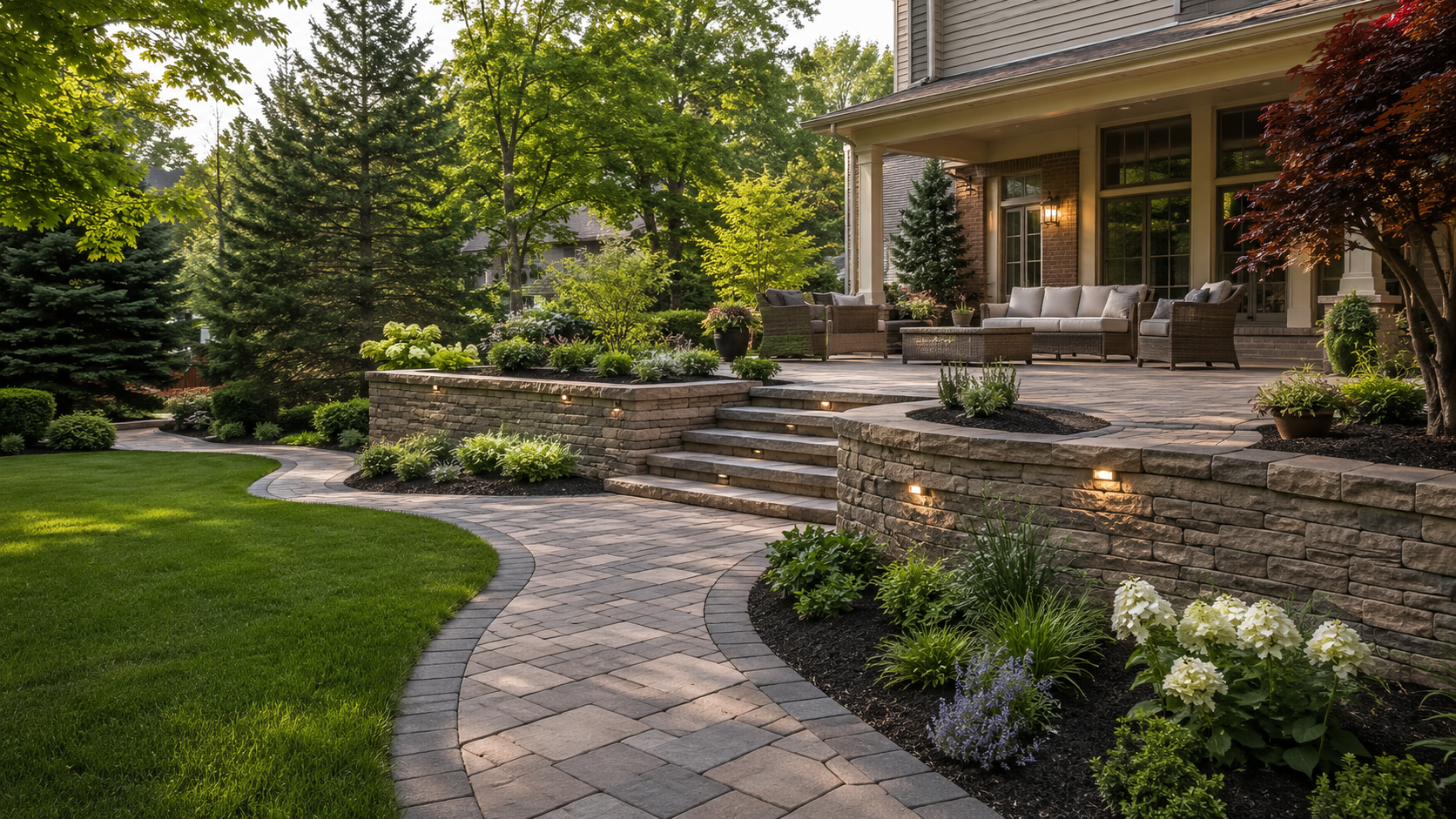
Retaining walls often solve one problem while making other improvements possible. They can support patios, define outdoor rooms, stabilize planting terraces, and help outdoor living areas fit the site more naturally.
That is why they often work best when they are part of a coordinated
hardscape design plan rather than treated as a standalone add-on. When the wall, the drainage, the grade, and the adjacent features are planned together, the property performs better and the project feels more cohesive.
A well-executed retaining wall is not just holding back earth. It is supporting the next layer of the site’s long-term use.
A Final Read on the Site: Is a Retaining Wall the Right Next Move?
Retaining walls are not one-size-fits-all landscape features. They are structural tools, and they make sense only when the site actually needs structural help. In Metro Detroit, that usually means dealing with slope pressure, erosion, drainage, or the need to create usable space where the existing grade does not allow it.
The best first step is not choosing a block style online. It is evaluating the site honestly. If the property is losing soil, routing water poorly, limiting outdoor use, or showing signs of grade instability, then a retaining wall may be the right next move. If it is not, there may be a simpler solution. Either way, the decision should come from site conditions, not assumptions.
Retaining Wall Questions Metro Detroit Homeowners Ask Before They Build
How do I know if my yard actually needs a retaining wall?
A retaining wall may be needed if the property has ongoing erosion, sharp grade changes, or drainage patterns that cannot be corrected with simpler grading alone. It is also common when a homeowner wants to create usable space on sloped ground.
Do retaining walls need drainage behind them?
Yes. In most structural applications, drainage is essential. Water pressure behind the wall is one of the main causes of failure, especially in climates with heavy saturation and freeze thaw cycles.
What material lasts longest in Michigan?
The best material depends on the site and the application, but engineered segmental block systems and properly installed natural stone are among the strongest long-term options when they are built correctly for local conditions.
Why do retaining wall quotes vary so much?
Because the visible wall is only part of the work. Quotes vary based on drainage needs, excavation depth, access, site pressure, material type, reinforcement, and whether the proposal includes the structural work needed for long-term performance.
Can a retaining wall be added later as part of a larger patio project?
Yes, but it is often smarter to plan the wall and the patio together. If the wall will support or influence the patio layout, early coordination usually produces a better result and reduces rework later.