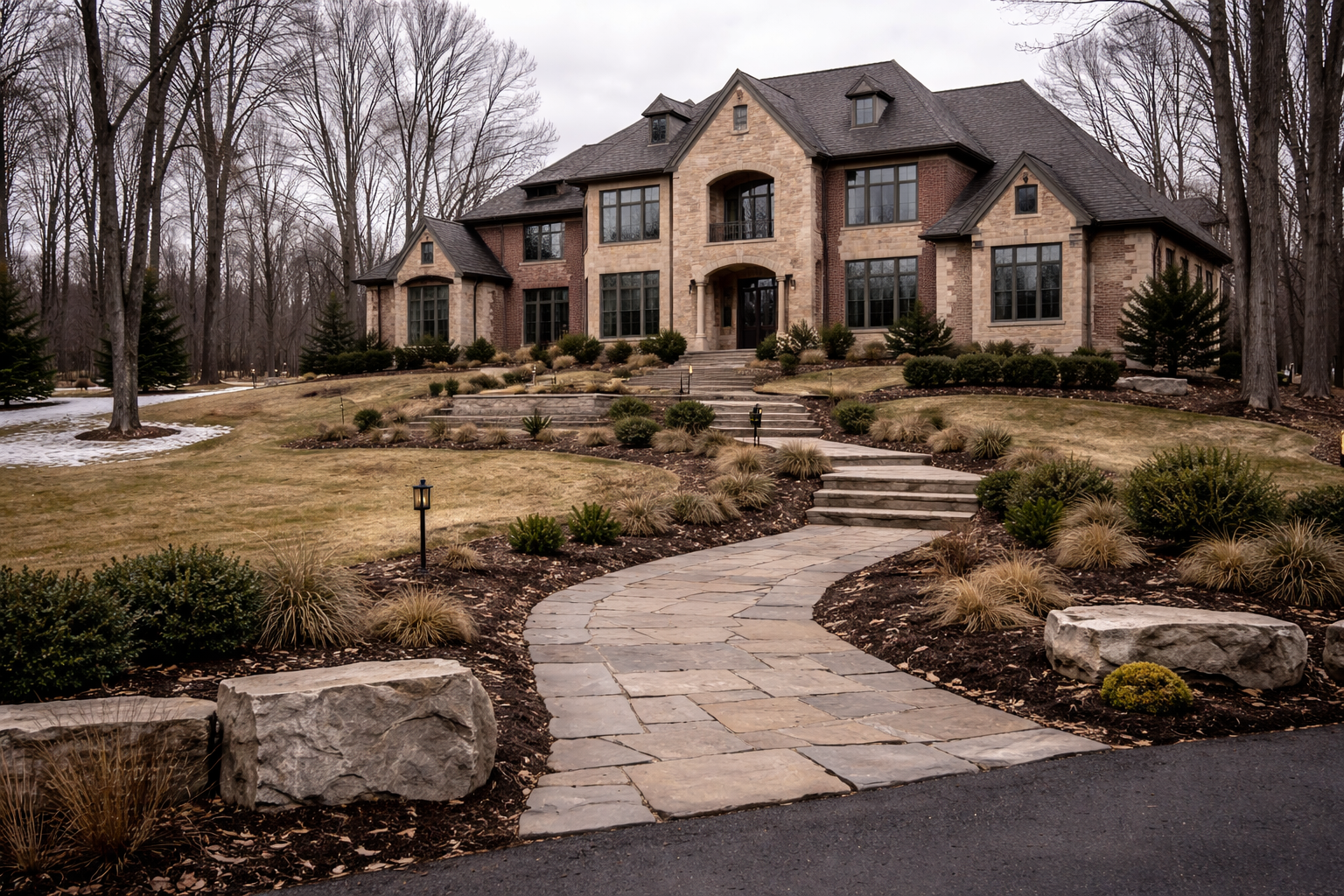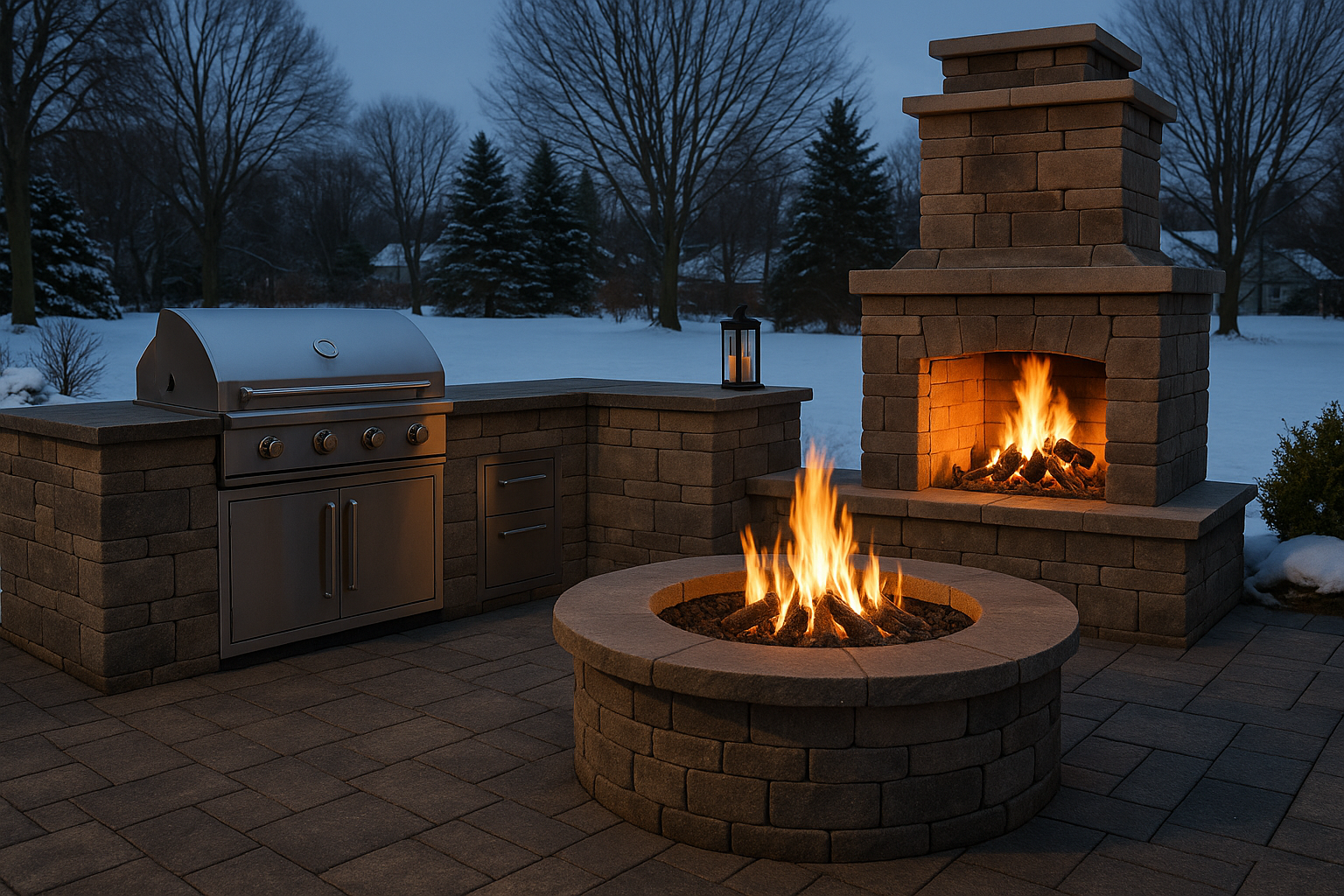
Brick Paver Patios: Durability Choices That Matter in Freeze-Thaw + De-Icing Salt
A patio can look perfect the week it’s finished and still be headed for failure. In Metro Detroit, the early warning signs—slight rocking, widening joints, a faint dip where water sits—usually show up after the first winter or two. By the time the surface looks “bad,” the underlying issues have often been present from day one.
This article is a durability-first guide to planning and building
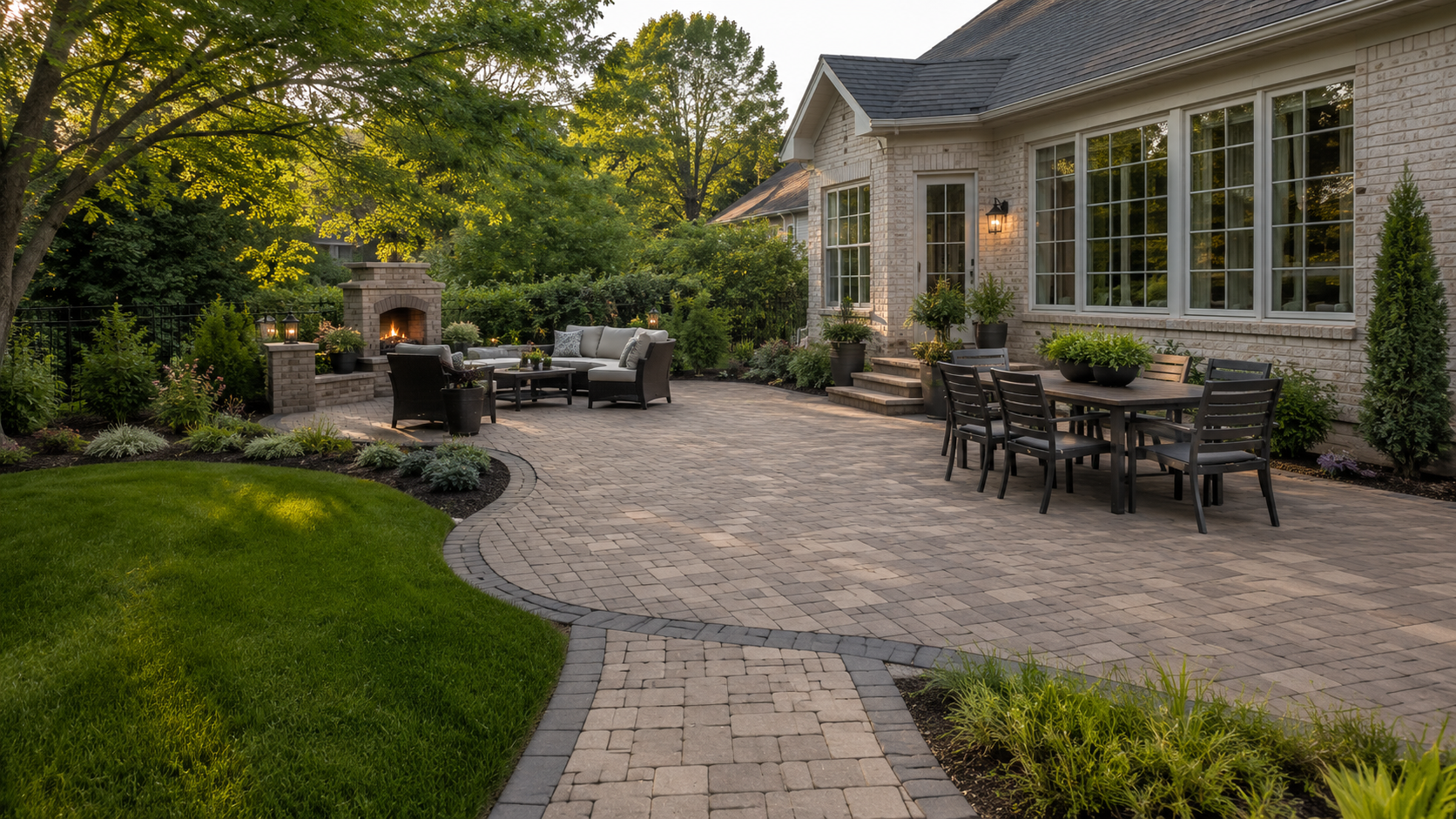
brick paver patios that hold their lines through freeze-thaw cycles and repeated de-icing. The focus is not on trendy patterns or showroom photos. It’s on the decisions that control shifting, staining, joint loss, and the subtle settling that makes a patio feel worn long before it should.
Hardscape Design & Installation
Why brick paver patios fail in Michigan, and why it’s usually preventable
Most patio problems get blamed on weather. Weather plays a role, but the real driver is almost always water in the wrong place. Freeze-thaw is hard on any hardscape, but it becomes destructive when water is allowed to sit within the system, saturate the base, and refreeze repeatedly.
A durable patio is not defined by a single material choice. It is defined by a complete system: site grading, drainage planning, base preparation, jointing, edge restraint, and thoughtful details where the patio connects to the house and landscape.
Freeze-thaw isn’t the problem by itself; trapped water is
When water infiltrates and stays within the base layers, freezing expands it. Expansion creates upward pressure and movement. Thawing allows the system to relax, but it rarely returns to the same position. Over time, this cycle creates the familiar pattern of unevenness: corners that lift, edges that drift, and low pockets that collect water.
Durability starts with two goals:
- keep water moving away from the patio surface,
- and keep the base layers stable and well-compacted so they do not change shape under seasonal stress.
De-icing salt: what it does to surfaces, joints, and edges over time
De-icing products influence patios in ways homeowners do not always expect.
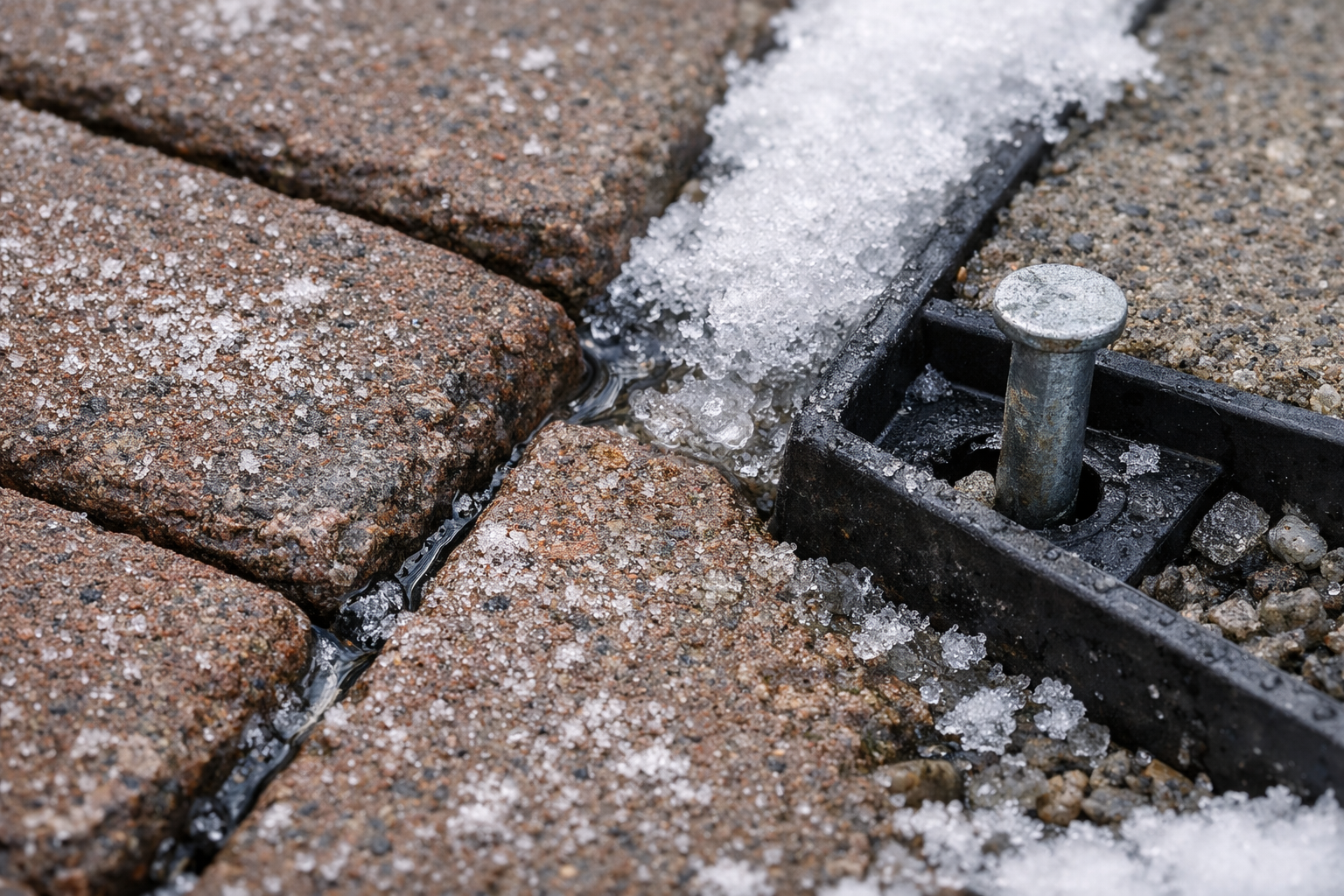
Salt can contribute to surface residue and staining, especially on lighter colors and textured finishes where particles settle. It can also accelerate wear at the joints by increasing moisture movement and encouraging washout when snowmelt carries fine material away.
Salt is part of Michigan life. The goal is not to avoid it entirely. The goal is to choose finishes and joint strategies that tolerate it, and to design the patio so meltwater does not sit long enough to concentrate residue.
The difference between “looks great now” and “stays great in five winters”
A patio that “looks great now” is often judged by straight lines and clean joints on day one. A patio that stays great has deeper indicators:
- consistent pitch that moves water away,
- edges that hold their geometry,
- joints that remain full and stable,
- and transitions that stay flush through seasonal movement.
Those outcomes are rarely accidental. They come from decisions made before the first paver is placed.
Start with the site: drainage, grade, and where water wants to sit
The most important durability decision is choosing a patio location and layout that respects the site’s natural water behavior.
A patio placed in a low point can be made to “work,” but it will require more intervention: regrading, drainage solutions, and careful planning at transitions. A patio placed where water naturally sheds away typically lasts longer with fewer recurring problems.
How to spot the patio locations that are high-risk for pooling and refreeze
High-risk patio locations often share a few traits:
- low areas where yard runoff naturally collects,
- zones that receive downspout discharge or roof meltwater,
- shaded pockets where snow lingers and meltwater refreezes,
- and areas near slopes where water travels across the surface during storms.
Homeowners can identify risk by watching after heavy rain and during spring snowmelt. If water consistently sits in the same areas, a patio built there needs a plan that moves water away—not just a surface that “covers” it. Clay soils common across Metro Detroit hold water, so understanding Detroit soil and drainage planning for clay soil is part of choosing a patio location.
Pitch and runoff planning: what “good drainage” actually means on a patio
“Good drainage” is often discussed like a slogan. In practice, it means the patio surface is pitched intentionally, and water has a clear path off the surface and away from the structure.
A durable patio avoids:
- flat planes that hold thin films of water,
- pitches that push water toward the house,
- and edge conditions where runoff is trapped against a lawn lip or bed border.
Drainage is not only about pitch. It is also about where the water goes once it leaves the patio. If runoff pools at the perimeter, it can saturate edges and base layers.
Connecting the patio to the yard so water doesn’t get trapped at transitions
Transitions are where water problems hide.
If the patio edge meets turf and the turf sits slightly higher, water can be trapped at the perimeter. If planting beds are built as “walls” along the patio, runoff can have nowhere to go. If a step down from the house lands on a flat surface, that landing becomes a refreeze point.
A strong plan treats transitions as part of the drainage design: edges, steps, and adjacent grades are coordinated so water can move naturally.
Base prep: the non-negotiables that determine longevity
Base preparation is the least visible part of a patio and the most consequential. In freeze-thaw climates, base quality determines whether the surface stays locked or slowly migrates.
Base depth, compaction, and consistency, why “good enough” is not good enough
Compaction is not a single pass with a machine. It is a method: building in lifts, compacting evenly, and maintaining consistent depth across the patio footprint.
When base depth varies or compaction is inconsistent, the patio behaves like a patchwork. Some areas settle more than others. That uneven movement shows up as rocking pavers, widened joints, and subtle waves in the surface.
Homeowners should not have to micromanage this, but they should understand the stakes: shortcuts in base work are among the most expensive problems to correct later.
Material layers: what the base is doing structurally (and what it can’t fix later)
A patio base is doing three jobs at once:
- distributing load so the surface does not compress unevenly,
- resisting movement from freeze-thaw forces,
- and supporting drainage so water does not remain trapped.
Once the patio is installed, the base cannot be “improved” without removing the surface. That’s why durability decisions must be made at the beginning.
Edge restraint strategy: where shifting starts and how to prevent it
Most patio movement begins at the perimeter.
Edges spread and settle first because they are exposed and because they resist the lateral forces created by foot traffic, furniture movement, and seasonal expansion. Strong edge restraint is what keeps the surface locked.
Perimeter control is not just structural. It is also visual. Crisp lines and stable borders are what make a patio look finished year after year.
Jointing decisions that control stability, weeds, and washout
Jointing is not an afterthought. It’s part of the structural performance of the surface.
Joint width and sand choice: how movement begins at the joints
Joints allow a paver surface to behave as a system. If joint widths are inconsistent, pavers can move unevenly. If joint material is not stable, joints wash out and allow more water into the bedding layer.
A well-executed joint plan supports stability and makes maintenance more predictable.
What causes joint erosion after heavy rains and snowmelt
Joint erosion is often driven by water volume and water speed.
Snowmelt can carry fine particles out of joints, especially when runoff crosses the patio and exits over a perimeter edge. Heavy rain can do the same if the patio is pitched in a way that concentrates flow.
This is another reason drainage design matters: reducing water movement across joints reduces long-term joint loss.
How jointing choices affect de-icing salt behavior and surface staining
Salt residue tends to collect where water sits and evaporates. Joints can act as collection points if the surface holds moisture or if runoff slows and deposits residue.
Jointing choices and surface pitch work together. The goal is to reduce standing moisture so residue does not concentrate in the same zones repeatedly.
Paver selection: durability vs. aesthetics in real-world conditions
Paver selection should be guided by how the patio will be used and what conditions it will face. A dining patio with frequent chair movement is different from a low-traffic garden terrace. A patio that receives heavy shade is different from one in full sun.
Finish and texture: traction, wear, and salt residue visibility
Texture influences traction and cleaning.
A very smooth surface can show less residue but can become slick when wet. A textured surface can provide better grip but may hold residue more visibly and require more attention in spring cleaning.
The right choice depends on exposure, slope, and how the patio will be maintained.
Color selection: what shows staining and what hides it (and the tradeoffs)
Lighter colors can highlight salt residue and winter grime. Darker colors can hide dirt but may show light residue depending on finish.
The best way to choose color is to view real installations in similar exposure. Homeowners should aim for a choice that still looks good in late winter and early spring—not only on day one.
Matching paver type to use: dining, fire feature zones, high-traffic paths
Use should inform paver selection.
- Dining zones benefit from stable, even surfaces that keep chair legs from rocking.
- Fire feature zones need materials and joints that handle heat exposure and ash cleanup.
- High-traffic paths need traction and durability where foot traffic concentrates.
A patio that feels good to use tends to stay in use, which is the real point of building it.
Brick, concrete pavers or natural stone
Brick, concrete pavers and natural stone can all make durable patios on a proper base. The decision usually comes down to three questions. Which suits the house? Clay brick suits traditional and historic brick homes, concrete pavers (including large formats) suit newer and contemporary homes, and natural stone reads as timeless across many styles. How will the surface be used? Dining zones need stable, even units, paths need traction, and fire feature zones need materials and joints that handle heat and ash cleanup. How much variation can the build absorb? Natural stone varies in thickness and shape, so it needs more experienced installation to finish flat and stable. For paths specifically, see stone versus brick walkways.
“Patio construction” details that separate premium builds from average installs
Details do not just affect aesthetics. They affect repairability, longevity, and how the patio ages.
Layout and pattern planning: how geometry affects shifting and repairs
Good patio construction begins with layout that respects geometry.
Patterns should align cleanly with key sightlines: the back door, major windows, primary seating zones. When layout is rushed, patterns can land awkwardly at edges and create narrow cuts that are more likely to loosen over time.
Geometry also affects repairability. A pattern that is carefully planned can be lifted and reset later without looking patched. A poorly planned layout often shows every repair.
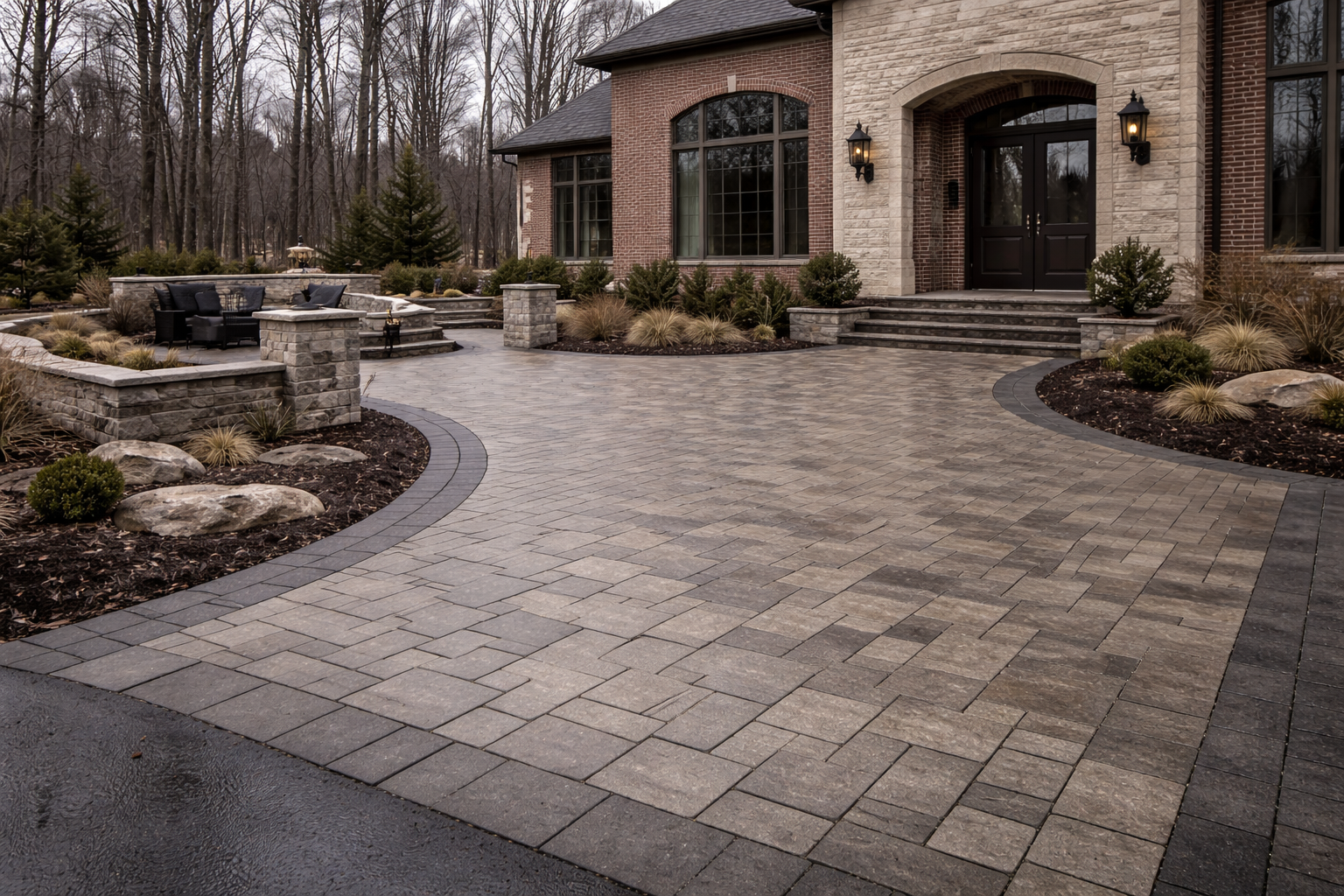
Borders and soldier courses: when they help and when they become failure points
Borders can frame the patio and elevate the look. They can also become the first failure point if perimeter control is weak.
Borders need to be engineered as part of the edge restraint plan. When they are treated as surface-level decoration, they separate and drift.
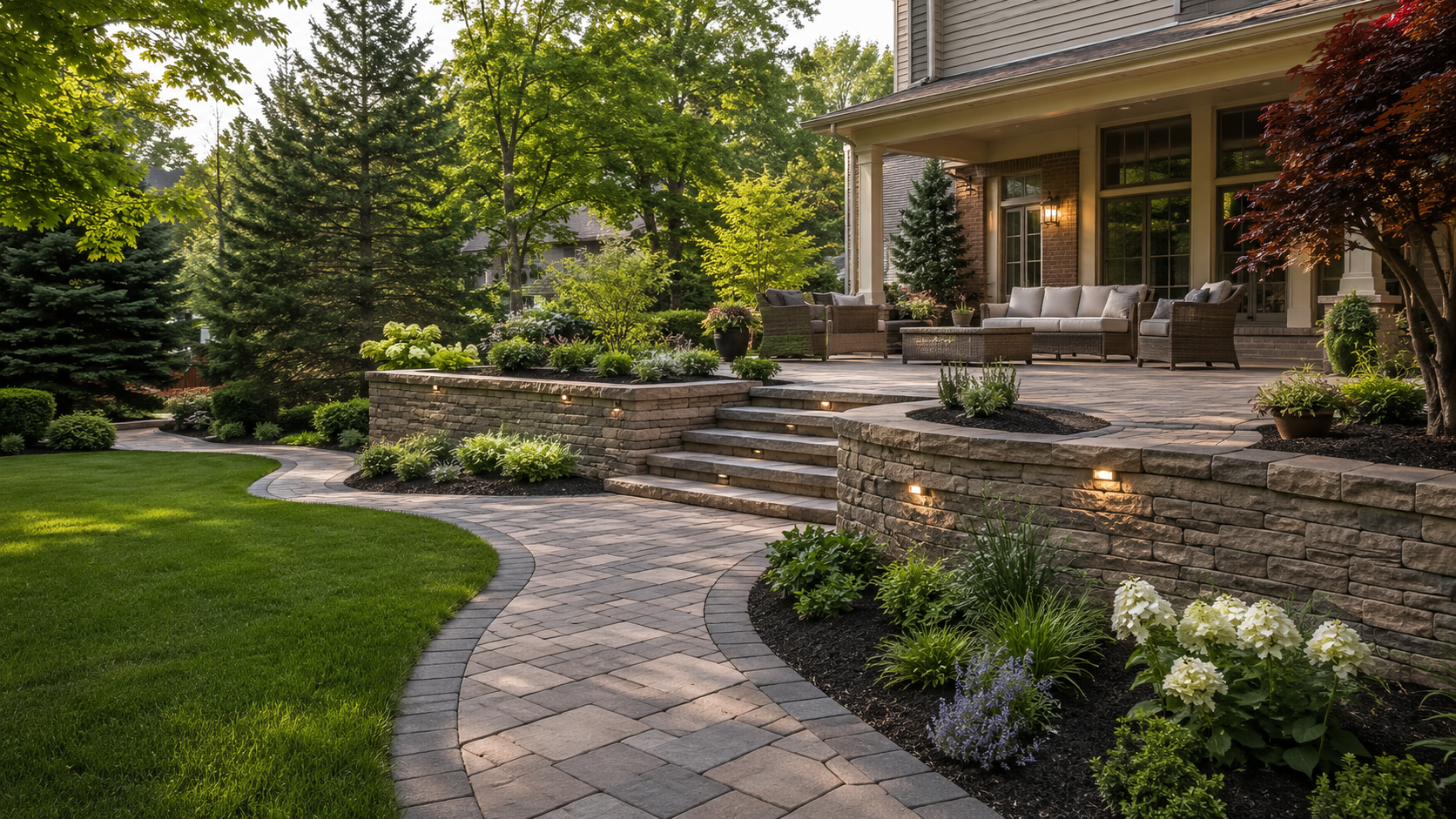
Steps, landings, and thresholds: where settling becomes most noticeable
Settlement is most visible at transitions:
- where the patio meets a door threshold,
- where a landing meets the first step,
- where a step meets the patio plane.
These points require careful planning and consistent base support. A patio can tolerate minor movement in a broad field area. It cannot hide movement at a door.
Integration points that make or break a patio over time
Most patio failures begin at integration points—where different systems meet.
Where patios fail first: door thresholds, steps, grill zones, and downspout paths
Door thresholds and steps are sensitive because even small settling becomes obvious and sometimes unsafe.
Grill zones and cooking areas are sensitive because grease, heat, and frequent foot traffic concentrate there. Downspout paths are sensitive because they introduce repeated water volume.
A durable plan identifies these points early and designs around them rather than treating them as minor details.
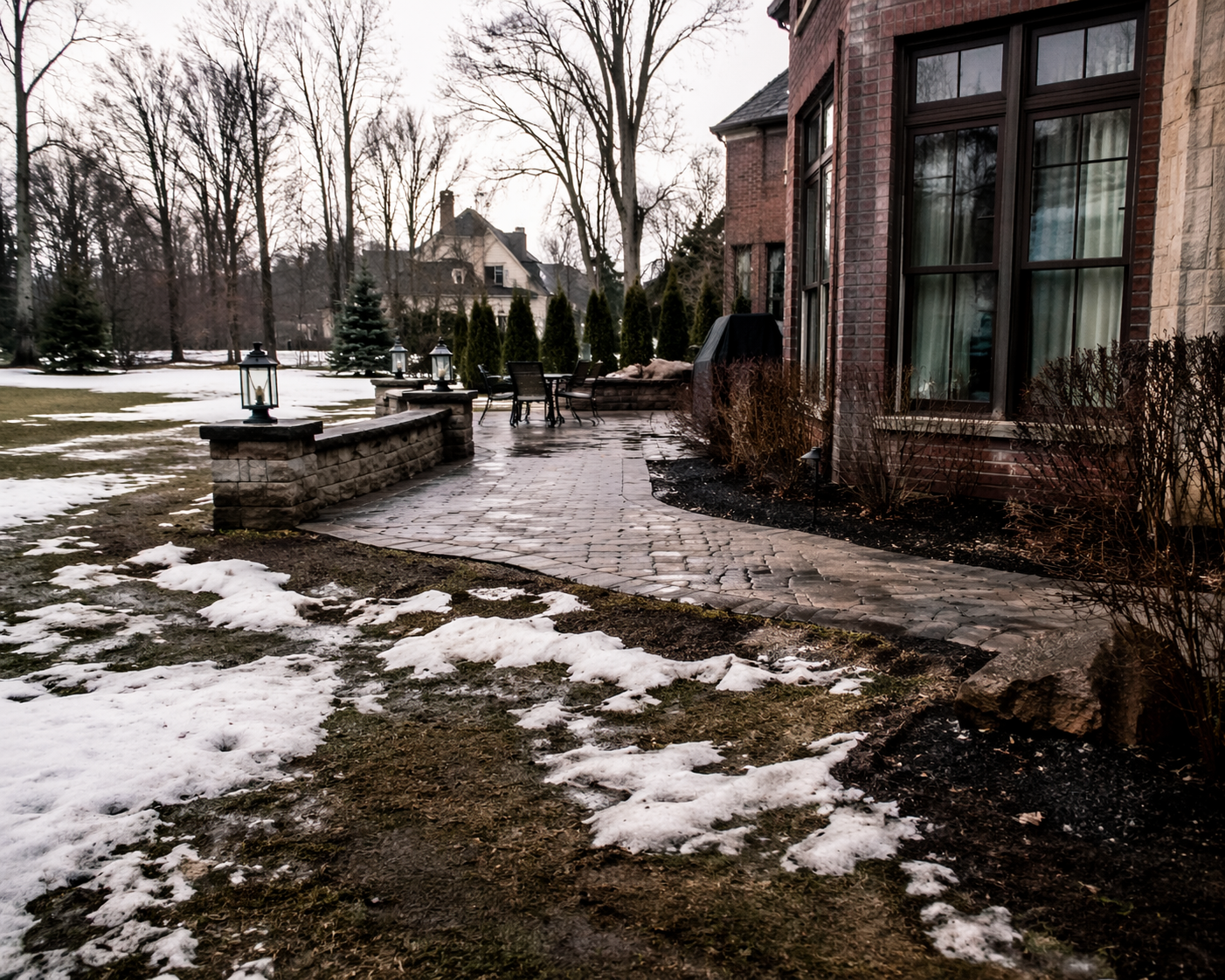
Managing water at the perimeter: lawn edges, bed edges, and retaining transitions
Perimeter edges can trap water if adjacent grades are not coordinated.
A patio edge should not function as a dam. If runoff cannot escape, it saturates the edge and invites movement.
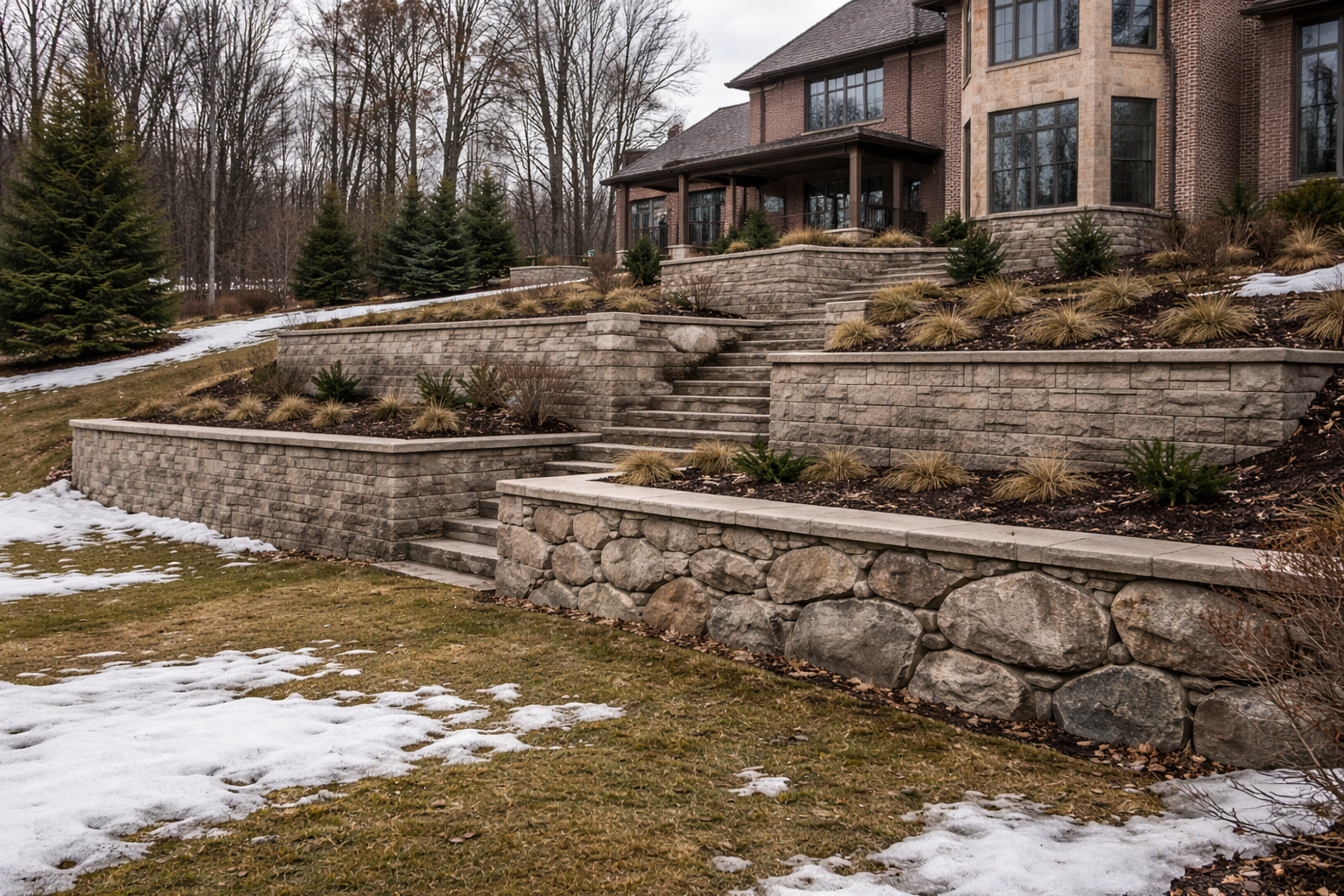
Where retaining transitions exist, the connection must be stable and designed to resist movement from both sides.
Planning for future changes: lighting, seating walls, outdoor kitchens
Many homeowners add features later: lighting, a seating wall, a grill structure, or a full outdoor kitchen.
Planning for these early can prevent expensive rework. Even if the feature is not installed immediately, the patio can be designed to support it with appropriate base reinforcement and utility planning.
Durability checklist for brick paver patios in Metro Detroit
This checklist is designed to make durability concrete. It helps homeowners ask the right questions and confirm that critical details are handled before they are buried under finished surface.
A homeowner walk-through: what to confirm before construction begins
A durable patio begins with clarity.
For
brick paver patios, homeowners should confirm:
- where water will go during heavy rain and snowmelt,
- how pitch will be established and verified,
- what the perimeter restraint strategy is,
- how transitions will be handled at doors and steps,
- and how joints will be filled and maintained.
This is not about micromanaging the contractor. It is about confirming that durability is built into the plan.
What to verify during the build (the moments you can’t “inspect later”)
Certain moments are impossible to verify once the surface is finished:
- base depth and compaction consistency,
- edge restraint installation,
- drainage elements integrated beneath or around the patio,
- and bedding layer preparation.
A quality team documents and explains these stages clearly.
What a finished patio should look like up close: lines, pitch, joints, and edges
Up close, a finished patio should feel consistent underfoot. Joints should be even. Lines should read clean without wandering. The pitch should be subtle but functional—enough to move water without feeling sloped.
Edges should look intentional and hold their form. A patio that feels “tight” up close is usually the one that will age well.
Choosing a contractor: how to evaluate the build process, not just photos
Photos show aesthetics. Process determines whether that look holds.
What to ask about base, drainage, and edge restraint (and how to spot vague answers)
Homeowners should ask process questions that reveal depth:
- How will water be moved away from the patio surface and perimeter?
- How will pitch be established and checked during the build?
- What perimeter restraint method is used, and why?
Vague answers usually sound like reassurance rather than explanation. A confident contractor can describe the approach without overselling it.
What a real warranty covers in practice (and what it usually excludes)
Warranties vary. What matters is understanding the practical scope.
Most warranties exclude damage caused by extraordinary site conditions or unrelated structural issues. Homeowners should clarify what is covered: shifting, joint loss, drainage-related settling, or surface defects.
The best indicator of quality is less the warranty language and more the contractor’s commitment to a process that prevents problems.
The proposal details that signal quality and accountability
A proposal that reflects quality usually includes:
- clear scope of base and drainage approach,
- a defined plan for joints and edge restraint,
- a description of how transitions are handled,
- and a clear process for changes.
This is where hardscape design and hardscape installation should be visible in writing, not implied by a photo gallery.
Luxury hardscapes: where the “luxury” is actually built
Luxury is often misunderstood as “more.” In reality, luxury is usually “better resolved.”
A patio feels high-end when the proportions make sense, the lines align with the home, and the transitions look effortless. That effect comes from thoughtful planning and careful execution, especially in the details people don’t immediately notice.
What separates high-end patios visually: transitions, alignment, and restraint
High-end patios tend to share a few traits:
- surfaces align with architecture rather than cutting across it,
- borders and patterns serve the composition rather than dominating it,
- and transitions between materials are clean and logical.
Restraint is part of the look. When every feature competes for attention, the result reads busy instead of refined.
Where luxury projects quietly spend time: details that don’t photograph well
Time gets spent on things that rarely make it into a portfolio shot:
- making sure pitch is consistent and water moves correctly,
- ensuring step geometry feels comfortable,
- keeping lines clean across long runs,
- and building stable edges that hold shape through seasons.
These are the decisions that keep luxury hardscapes from aging prematurely.
How to invest for the result (without buying unnecessary complexity)
Homeowners can invest intelligently by prioritizing:
- durable base preparation,
- coherent layout,
- clean transitions,
- and a few high-impact details rather than many small add-ons.
The goal is a patio that feels calm and finished—not one that feels decorated.
Next steps: how to scope, price, and plan your patio with confidence
A patio project becomes smooth when scope is clear early. The more decisions are made up front, the fewer surprises appear during installation.
The decisions that lock pricing fastest: layout, paver selection, borders, drainage approach
Pricing becomes dependable when the layout is established, pavers are selected (or allowances are clearly defined), borders are decided, and drainage approach is resolved.
Without these decisions, estimates remain broad. With them, proposals become comparable.
How to compare bids without guessing what’s missing
When comparing bids, focus on what is written:
- Does the proposal describe base scope and perimeter restraint clearly?
- Is drainage handled thoughtfully or brushed aside?
- Are joints, borders, and transitions defined?
If the most critical details are unclear, ask for clarification. A durable patio is built on specifics.
Planning the timeline around weather, access, and disruption
Michigan weather is part of every schedule. A good plan accounts for access, staging, and the realities of working around rain periods.
Homeowners should also plan for disruption: site access, outdoor use limitations during construction, and the time needed for final detailing and cleanup.
FAQs
Do brick paver patios require sealing in Michigan?
Sealing can help in certain situations, but it is not a universal requirement. The more important question is what problem sealing is intended to solve: staining, color consistency, or easier cleaning. Sealing does not replace proper drainage and base work. If the patio holds water or the joints wash out, sealing will not fix the underlying issue.
What causes pavers to rock or feel uneven after a winter?
Rocking usually traces back to inconsistent base compaction, bedding layer issues, or water movement that changed the support beneath specific pavers. Freeze-thaw becomes disruptive when water saturates the system and refreezes. The fix often requires lifting and correcting the base in the affected area, not simply re-sanding the joints.
How can I reduce salt staining on my patio?
The best approach is design-first: ensure water moves off the patio and does not pool where salt concentrates. Material selection also matters—some colors and finishes show residue more readily. Spring cleanup habits help, but the long-term solution is limiting standing moisture and avoiding situations where meltwater repeatedly evaporates in the same zones.
Are borders and patterns worth it, or do they create problems?
Borders and patterns can elevate the look when they are supported structurally. They become problems when edge restraint is weak or base work is inconsistent. If detail is part of the design, it should be treated as part of the system—not as decoration placed on top of an average build.
What should I expect a quality proposal to include?
A quality proposal should describe how the base will be built, how drainage and pitch will be handled, how the perimeter will be restrained, and how joints and transitions will be executed. It should be specific enough that you understand what is being built beneath the finished surface.
How do I know if my yard needs drainage work before a patio is installed?
If water sits in the planned patio area after rain or during snowmelt, or if runoff regularly crosses that zone, drainage planning should be part of the project. A patio can be built in many areas, but durability depends on whether water movement is handled intentionally rather than hoped away.
Closing
A brick paver patio earns its value over time. The real payoff is not the day it’s finished. It’s five winters later, when the surface still feels solid underfoot, the joints remain stable, and water sheds cleanly instead of freezing into recurring problems.
If the goal is a patio that stays tight and refined through Michigan weather, prioritize the system: drainage planning, base preparation, edge restraint, and clean transitions. Those choices are not the most visible, but they are the ones that protect everything you can see.
For homeowners planning a new patio—or evaluating why an existing patio is shifting—Rohto can walk the site, identify the durability risks, and outline a build approach that fits the property and the way the space will be used.